

Launch of the GQII 2025 Report
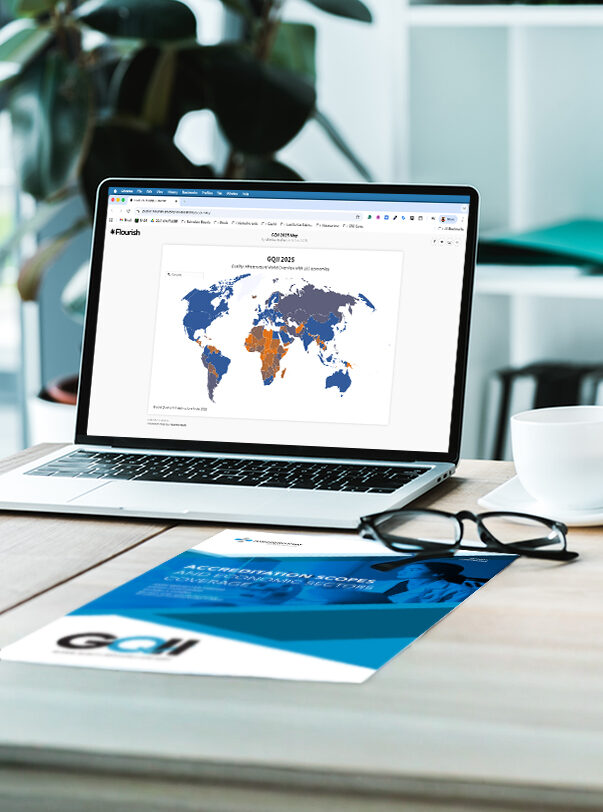
The Global Quality Infrastructure Index (GQII) 2025 was launched on 9 December 2025 in an online event hosted by PTB’s International Cooperation group which brought together almost 180 policymakers, practitioners, researchers and development partners from around the world. The index, compiled by Mesopartner with support from the German Federal Ministry for Economic Cooperation and Development (Bundesministerium für wirtschaftliche Zusammenarbeit und Entwicklung (BMZ)) and the Physikalisch-Technische Bundesanstalt, PTB, presents the development status of national quality infrastructure (QI) systems in 185 economies and has confirmed its role as a key reference for evidence-based QI reform.
What GQII 2025 delivers
The GQII 2025 provides an updated database and ranking that integrates official information from metrology, standardization and accreditation organizations into a single, comparable framework. The new edition refines the three‑pillar architecture and uses percentile ranks to harmonize diverse indicators, enabling users to track trajectories over time and benchmark countries and regions more easily.
The report documents how quality infrastructure is increasingly intertwined with global trade, sustainable development and technological transformation, and it explores correlations with indicators such as trade openness, economic complexity and institutional quality. Participants at the launch discussed how these findings can support policy dialogue, project design and research agendas in partner countries and international organizations.
Highlights from the launch event
In her opening remarks, Annette Röttger, Member of PTB’s Presidential Board, underlined the relevance of the GQII for PTB’s long‑standing work in strengthening metrology and quality infrastructure in partner countries. Alejandro Rivera Rojas from UNIDO highlighted the significance of conducting evidence-based assessments of QI system trajectories for sustainable development. He related the index to the QI4SD Index and underscored their complementary natures. Philip Grinsted from The World Bank reflected on the importance of having data to inform policymakers, helping to translate abstract QI systems into something that can be measured, tracked and acted upon. He mentioned that the World Bank draws on the GQII in its analytical work, as well as its broader development diagnostics at the country level, and the World Development Report 2025 titled ‘Standards for Development’ which was released on 11 December 2025.
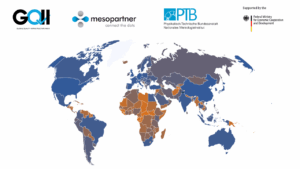
Illustration © Mesopartner
Ulrich Harmes-Liedtke, creator of the GQII and lead author of the 2025 report, presented key methodological innovations and global trends, including shifts in QI maturity across world regions and the evolution of specific QI areas over time. Ann-Sara Ramkissoon, doctoral student at the University of Florence and co-author of the report, showed how the GQII dataset can be used for empirical research on QI and how it helps to develop related indices, such as the Global Accreditation Experience Index (GAEI) and the Global Accreditation Coverage Count (GACC). Both derived indices serve as frameworks for benchmarking accreditation competencies, utilizing long-term data series.
A dynamic Q&A session enabled participants to discuss how the GQII impacts policy creation and strategic decisions. It also examined the extent to which it helps assess the effectiveness of a national QI system and what it indicates about the contributions of QI to economic growth. In her closing remarks, Marion Stoldt, Head of PTB’s International Cooperation group (Q.3), emphasized that robust, openly available data such as GQII 2025 are essential for steering international development cooperation in QI and invited partners to make active use of the new edition in their work.
The GQII 2025 report, which became available on 13 February and can be downloaded, as well as presentations, videos, data sources and the ranking positions of the 185 economies surveyed can be found here: https://gqii.org/.
Cover image © Mesopartner